
In the modern B2B manufacturing landscape, delivering high-value furniture, sofas, and windows to global markets requires more than just flawless production. The ultimate challenge lies in backend logistics—specifically, mastering packing furniture for shipping and moving vulnerable architectural components over long distances without structural or cosmetic damage.
To protect profit margins and eliminate costly product returns, industry leaders are rapidly phasing out manual packaging workflows. Instead, modern factories are choosing advanced packaging technology and flexible transfer lines in automation to secure their outputs.
Whether your plant processes heavy solid wood elements, delicate window frames, or large upholstered sofas, integrating a dedicated automatic or semi automatic packaging machine is the single most effective way to optimize operational efficiency.
The Shift in Industrial Packaging Materials
For decades, the standard approach to factory logistics relied on manual labor and basic industrial packaging materials such as corrugated sheets, edge protectors, and hand-applied stretch film. While these methods offer baseline coverage, manual wrapping is inherently inconsistent, slow, and highly prone to human error.
Today’s high-volume production facilities demand smart material combinations applied with mechanical consistency:
- Shock Absorption: Innovative solutions like expanding foam packaging mold directly around irregular product geometries to absorb high-impact transit vibrations.
- Dual-Layer Shielding: For modular furniture panels and heavy profiles, combining a protective inner layer (such as PE foam or bubble wrap) with a high-tension outer layer via an automated horizontal wrapper delivers complete climate and physical protection.
Overcoming Logistics Bottlenecks in the Sofa and Furniture Sectors
Upholstered furniture and bulky sofas present a unique set of material handling challenges. Because they are heavy, irregularly shaped, and easily torn, implementing a specialized sofa packaging line transforms this notorious bottleneck into a streamlined, high-speed asset.
A fully integrated packaging cell from EDDA Packaging automates the entire flow:
- Integrated Weighing: The component moves onto the conveyor, where smart scales automatically capture the weight data for logistics logging.
- Protective Layering: The system mechanically applies an even layer of bubble wrap or PE foam mattress sheeting.
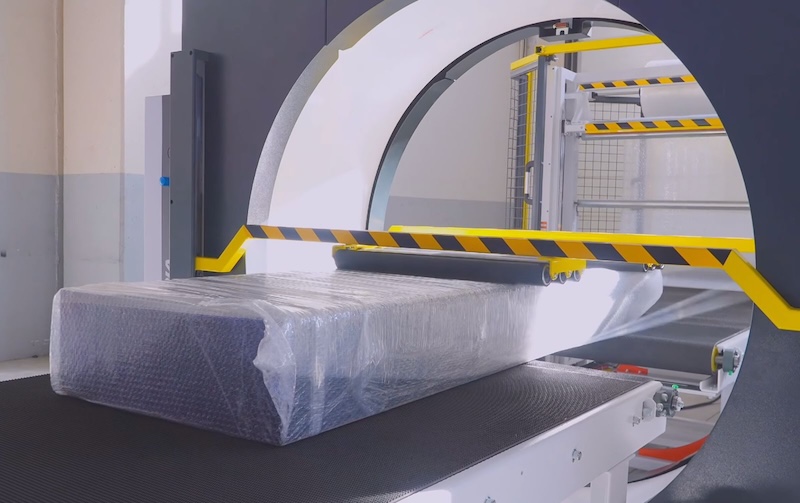
- Orbital Wrapping: The product passes through a high-frequency rotating ring that applies multi-layered stretch film at uniform tension, sealing the item completely.
- Heavy-Duty Tilting: Specialized 85-degree tilting conveyors or upenders safely rotate heavy sofas, preparing them for effortless, zero-labor palletizing and container loading.
This advanced structural layout compresses a multi-stage workflow down to under 60 seconds, drastically minimizing labor dependencies and cutting film waste by up to 40%.
Specialized Protection for Window Profiles and Long Components
Unlike corrugated cardboard furniture, glass windows, commercial doors, and extruded PVC or aluminum profiles require an entirely different mechanical approach. Delicate powder-coated frames and glass panes cannot tolerate shifting, friction, or moisture exposure during long-distance transit.
Heavy-duty horizontal orbital wrapping machines wrap heavy stretch film tightly around the entire length of the profile bundles. By creating a hermetically sealed wrap, the machinery completely blocks moisture ingress and keeps structural components rigid. This guarantees that your products arrive at the construction or installation site in the exact same pristine condition they left the factory floor.
Why Factory Automation Controls the Future of Logistics
The growing global collection of industrial automation videos and industrial case studies underscores a vital truth: automation is no longer a luxury—it is a core operational necessity. Transitioning from manual wrapping to automated systems solves two major manufacturing challenges simultaneously:
- The Labor Gap: Automated packaging lines take over grueling, repetitive physical tasks, allowing plant managers to transition valuable human resources into more technical roles.
- Predictable Operational Costs: Mechanical wrapping ensures the exact same film tension and material usage for every cycle, allowing for highly accurate budgeting.
To guarantee a seamless transition on the production floor, machinery manufacturers back their hardware with comprehensive packaging machine operator training and intuitive touch-screen human-machine interfaces (HMI), enabling existing factory staff to manage advanced lines with total confidence.
Conclusion: Partnering with EDDA for Industrial Packaging Lines
As global supply chains become faster and more demanding, your final packaging line dictates your delivery performance and customer satisfaction. Upgrading your shipping facility with a tailored packaging design tutorial and precision machinery is a direct investment in your manufacturing brand’s market reputation.
At EDDA Packaging, we specialize in engineering heavy-duty horizontal orbital wrappers, automated box-making machines, and custom conveyor systems. Our flexible solutions are designed to merge seamlessly into your existing layout, ensuring your sofas, windows, and industrial components are completely sealed and ready for international transport.
Are you ready to eliminate transit damage and scale your packaging throughput? Explore our full range of automated wrapping systems at www.eddapack.com or connect directly with our global engineering desk at info@eddapack.comto request a custom layout for your facility.
Horizontal wrappers are really efficient compared to heat-shrink tunnels and totally changed the game of packaging at panel furniture industry.