
Hand wrapping is still how a large share of pallets are secured, especially in warehouses, distribution centres and smaller production sites without a wrapping machine. In that segment, one product has been steadily replacing conventional hand rolls: pre-stretched film. It looks thinner, the rolls are lighter, and suppliers claim it does the same job with less plastic. Here is what it is, where it works well, where it does not, and how it is made.
What pre-stretched film is
Conventional stretch film is designed to be stretched during application. A wrapping machine with a powered pre-stretch unit typically elongates the film by 200% or more before it reaches the load. A person wrapping by hand cannot come close to that: most hand wrapping uses only a fraction of the film’s stretch capacity, so a lot of material ends up on the pallet without doing much work.
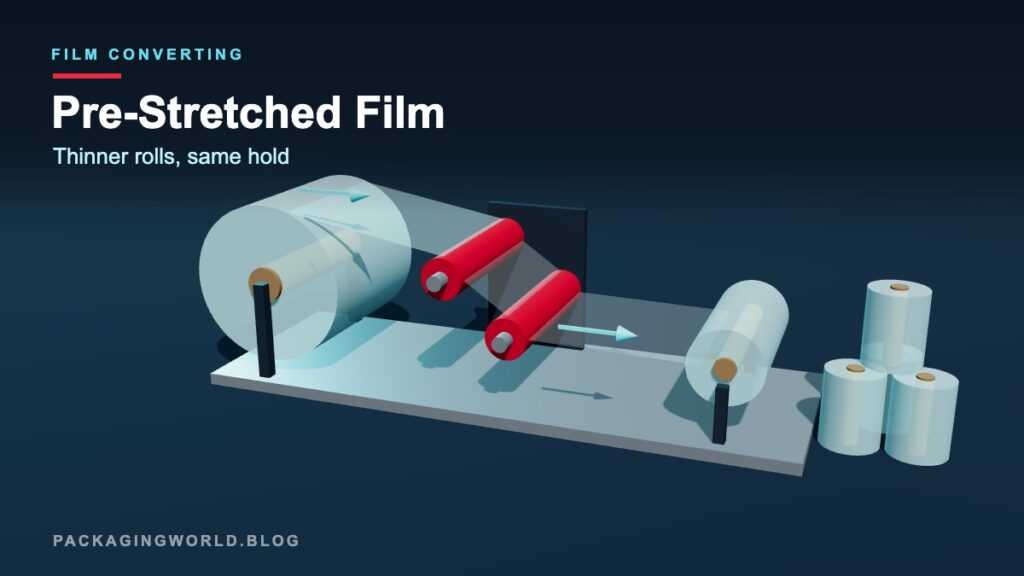
Pre-stretched film moves that step to the factory. The film is stretched close to its optimum point under controlled conditions, then wound onto rolls. The result is a thinner, already work-hardened film that needs very little force to apply and holds the load with less material.
Why it is gaining ground
- Less film per pallet. Because the stretch has already been done, the operator applies film that is close to its final state. Suppliers commonly cite material savings of 25% to 40% compared with conventional hand film; real results depend on the load and how it is wrapped, so a trial on your own pallets is the only reliable test.
- Lighter rolls and less effort. The same length of film weighs much less, and wrapping takes less pulling force. For staff wrapping dozens of pallets per shift, that is a noticeable ergonomic difference.
- More consistent results. Pre-stretched film narrows less during wrapping, so coverage is more predictable from one operator to the next.
- Less plastic in circulation. Lower packaging weight per load is becoming a commercial argument as well as an environmental one, with rules such as the EU packaging regulation pushing for less material. We covered that background in our 2026 packaging review.
Where it is not the right choice
Pre-stretched film is not a universal replacement. Because much of its elongation has already been used, it has less reserve stretch to absorb movement or wrap around irregular shapes. Loads with sharp edges or protruding parts may need a thicker conventional film or corner protection. And on automatic wrappers with powered pre-stretch, the machine already does the stretching, so the advantage largely disappears. The price per kilogram is also higher; the saving comes from using fewer kilograms, which is why a side-by-side test matters.
How pre-stretched film is made
Pre-stretched rolls are usually produced by film converters rather than by the original film extruder. The converter takes jumbo rolls of cast stretch film and runs them through a pre-stretch rewinder. Inside the machine, the film passes between rollers turning at different speeds, which elongates it by a set ratio. It is then slit to width if needed and wound onto cores as finished hand rolls.
The quality of the final product depends on control: a steady stretch ratio, even tension across the web and clean, straight roll edges. Converting lines such as the Universa 250 pre-stretch rewinder are built around these points and handle films of roughly 15 to 35 micron. The video below shows the process from jumbo roll to finished hand roll.
For packaging distributors and converters, this opens a business opportunity: the same jumbo rolls can be turned into a higher-value product with their own roll length, weight and branding. Our earlier article on slitting, rewinding and pre-stretch technologies looks at the wider range of film converting machines used for this work.
Questions to ask before switching
- What do your loads look like: regular cartons, or sharp and irregular shapes?
- Are your pallets wrapped by hand, on semi-automatic machines, or on fully automatic wrappers with powered pre-stretch?
- How much film do you use per pallet today, measured by weight rather than by number of rolls?
- Can your supplier provide trial rolls so you can compare load stability and film use on your own pallets?
Pre-stretched film is not magic, but for hand wrapping it is one of the simplest ways to cut film use without changing equipment. The key is to measure before and after, and to choose the film for the load rather than the other way round.