
Packing is often the last manual step in an otherwise automated furniture plant. Panels come off CNC lines and edge banders at high speed, then wait while people wrap, box and label them by hand. As volumes grow and labour gets harder to find, more manufacturers are looking at automated furniture packaging lines. This guide explains how these lines work for the three main product groups, what the typical steps are, and what to check before investing in furniture packaging machines.
Why packing becomes the bottleneck
- Speed mismatch: modern panel processing can produce parts far faster than a manual packing table can handle them.
- Inconsistent protection: hand packing varies from shift to shift, and damaged deliveries or returns usually trace back to weak spots in the pack.
- Material waste: oversized cartons, loose filler and generous film use add cost and are coming under pressure from packaging rules, as we discussed in our 2026 furniture packaging review.
- Labour: packing is physically demanding, repetitive work that is increasingly difficult to staff.
Three product groups, three approaches
“Furniture packaging” covers very different products, and no single machine suits them all. Most lines are built around one of three groups.
1. Flat-pack and ready-to-assemble furniture
Knock-down furniture is shipped as a kit of panels and fittings in a carton. Automated lines here focus on collecting the right parts, building a carton around them and closing it. Box-on-demand systems cut each carton to the size of the kit, which reduces void fill and freight volume; at the top end, fully automated lines such as Lotis Max run with little or no operator involvement. We covered this approach in our article on operatorless flat-pack packaging, and our box-on-demand checklist lists what to compare between systems.
2. Panels, fronts and cabinet doors
Kitchen fronts, wardrobe doors and lacquered panels are often shipped as individual parts, so surface protection matters most. The usual solution is an orbital stretch wrapper, often combined with a bubble wrap unit that lays cushioning on the top and bottom faces before the film is applied. Our article on bubble wrap and stretch film in one pass explains how such a line is laid out.
3. Sofas and upholstered furniture
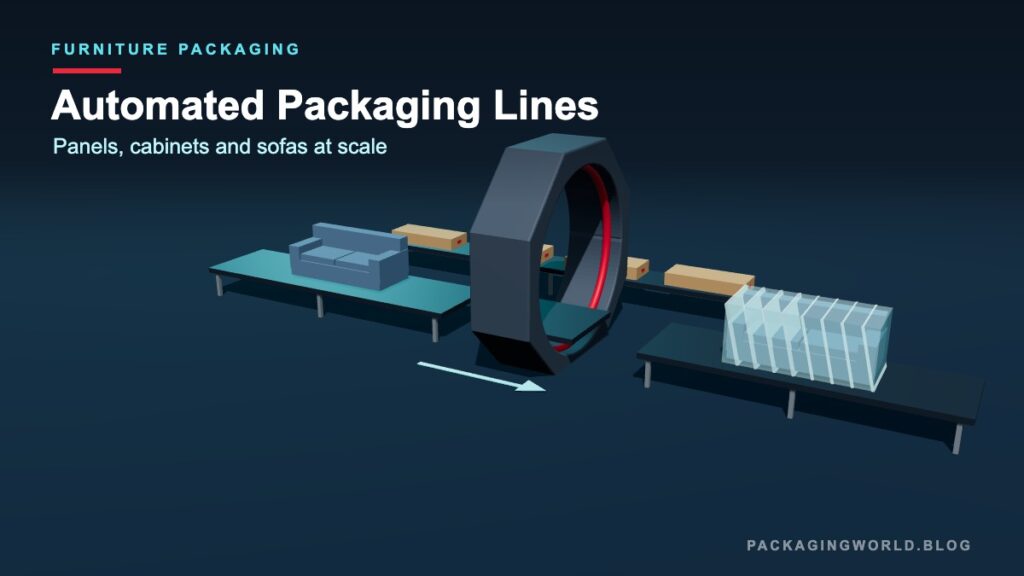
Upholstered furniture is bulky, soft and easily soiled, which makes manual wrapping slow and awkward. Dedicated lines move the sofa on a wide conveyor through a large orbital ring that wraps it in film, sometimes after a cushioning layer has been added. Lines in this category, such as the Spinner 1800 sofa packaging line, are typically sized around the largest sofa or corner module the plant produces. Modular systems take this further by combining several stations into one line; an overview of such equipment can be found under horizontal sofa packaging.
What a typical line looks like
Whatever the product, most automated furniture packaging lines follow the same sequence:
- Infeed: parts or finished items arrive from production on a conveyor, ideally without being lifted by hand.
- Protection: corner protectors, bubble wrap or foam are added where the product needs them.
- Wrapping or boxing: stretch film for panels and upholstery, cartons for flat-pack kits.
- Labelling: product, order or barcode labels are applied automatically or at a short manual station.
- Outfeed and stacking: packs are transferred to pallets or a buffer conveyor for dispatch.
The individual machines matter, but so do the transfers between them. A line that needs people to lift products between stations has only moved the bottleneck.
Questions to answer before investing
- What is the full range of products the line must handle, from the smallest part to the largest sofa or panel?
- How many packs per shift do you need today, and how many in three to five years?
- Which damage problems are you trying to solve, and which protection level do your customers expect?
- How much floor space is available, and can the line connect directly to production and dispatch?
- What materials will you use, and how will new packaging rules affect film and carton choices?
- Who will run and maintain the line, and what local service support is available?
Clear answers to these questions make supplier offers easier to compare and help avoid a line that is either oversized or too limited for the product mix. In most plants, the best results come from starting with the product group that causes the most damage or labour, and expanding from there.