
In a profile extrusion plant, the extruder and the saw are usually automated. Packing often is not. Profiles come off the cutting station at a steady pace, and then a team of people stacks, bundles, wraps and labels them by hand. A profile wrapping line closes that gap. This article looks at how PVC and aluminium extruders plan one: what the line has to do, which wrapping methods fit which output, and where projects typically go wrong.
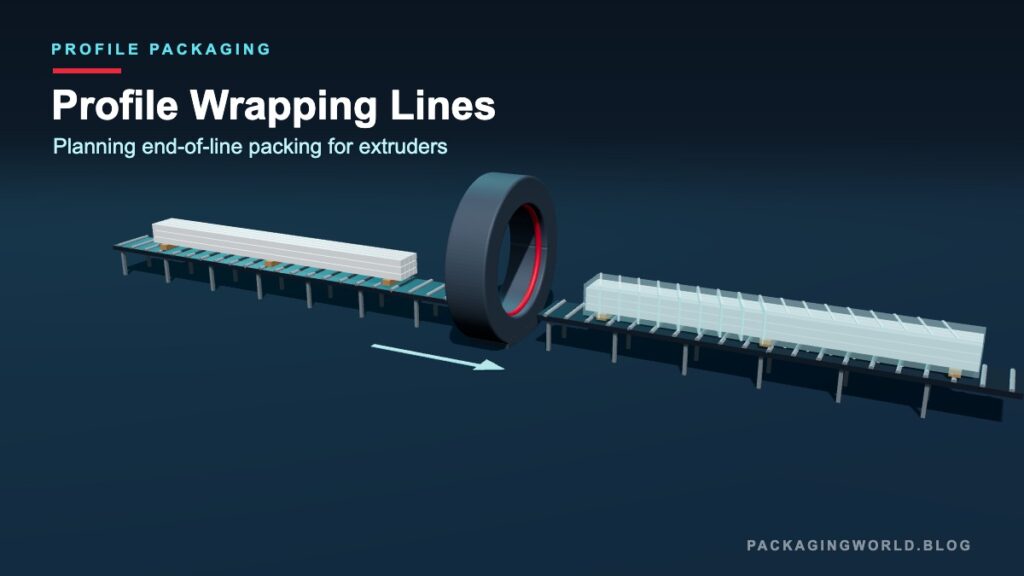
Start with what leaves the plant
The first decision is not the machine but the shipping unit. Extruders usually ship in one of three forms, and each leads to a different line:
- Single profiles or small packs, wrapped individually straight after cutting. This needs a wrapper that runs at extrusion speed and handles long, light parts.
- Bundles on wooden supports, the typical unit for wholesale and export. Here the wrapper must cope with heavy, long bundles and with the wooden spacers underneath.
- Banded or sleeved bundles, where profiles are held together with straps or a shrink sleeve instead of full stretch wrapping.
Many plants ship more than one of these, which is why it pays to map the volumes per format before talking to suppliers.
Matching the line to extrusion speed
A profile wrapping line has one non-negotiable requirement: it must keep up with production. If wrapping is slower than extrusion and cutting, profiles pile up and people end up packing by hand again. Useful figures to collect are the cut length (6 metres is common for PVC window profiles), the number of profiles per minute at peak, and how many lines will feed one packing station.
Wrappers built for single profiles typically run continuously on a belt conveyor, with one or two film units spiralling stretch film around the profile as it passes. Two film units allow a higher conveyor speed for the same overlap. Bundle wrappers work in cycles instead: the bundle is positioned, wrapped as it moves through a larger ring, and released. In one published project at a PVC profile manufacturer, an automated bundle line wraps a 6 metre bundle in under a minute and replaced a manual process that needed around ten people.
Stretch film, banding or shrink?
- Stretch wrapping gives full surface protection against dust, scratches and moisture and is the usual choice for visible PVC and anodised aluminium surfaces.
- Banding with a protective sleeve or film uses less material and is faster for robust profiles, but leaves more of the surface exposed.
- Shrink film lines wrap and seal profiles in a tight, closed pack, which suits some export and retail formats.
Whatever the method, the protective tape that many extruders apply to visible profile faces stays the first line of defence; the outer pack protects it and holds the bundle together. For frames and door leaves rather than raw profiles, see our door, window and profile packaging guide.
The parts of the line that are easy to overlook
- Infeed and transfer tables that take profiles from the saw without manual lifting.
- Wooden support handling: placing, centring and detecting the spacers so they are wrapped in, not taped on by hand.
- Labelling placed where it stays readable after wrapping, for traceability and order picking.
- Outfeed and stacking, so finished bundles can be collected by forklift without blocking the line.
- Safety and controls: light curtains around moving rings and a simple operator panel for recipe changes between profile types.
Questions to ask before you buy
- Which shipping formats do you need today, and in what share?
- What is the peak output per line, and how many lines feed the packing area?
- What are the longest, shortest and heaviest units, and the largest cross-section?
- How often do you change profile types, and how fast must changeover be?
- How much floor space is there between the saw and the warehouse?
- Which film or banding materials do your customers accept, and what do packaging rules require?
A well-planned profile wrapping line pays back through fewer people at the end of the line, lower film use and fewer transport claims. The machine is only one part of that; the transfers before and after it decide whether the line really keeps pace with extrusion.
Sources and further reading
Some of the sources we used while preparing this article:
- PVC profile wrapping machines: from single profiles to finished frames (Edda)
- Automatic PVC profile packaging line replaces manual wrapping (project report)
- Speedwrap Profiline PVC and aluminium profile packaging line
- Fully automatic profile wrapping and banding line
- Automated packaging lines overview