
Doors, window frames and PVC or aluminium profiles are among the most difficult products to ship. They are long, flat or slender, and their finished surfaces show every scratch. A single scuffed sash or dented profile can mean a site callback, a replacement part and a delayed installation, which usually costs far more than the packaging itself.
Why these products get damaged
- Abrasion: frames and profiles rub against each other in racks and stacks during transport, leaving marks on painted, laminated or anodised surfaces.
- Edge and corner impacts: long parts are handled at their ends, so corners take most of the knocks during loading and unloading.
- Site conditions: windows and doors often wait on construction sites for days, exposed to dust, rain and cement splashes.
- Hardware and glass: on finished windows, handles, hinges and glazing are the most fragile points.
Match the method to the product
There is no single right way to pack all three product groups. The shape of the product, the surface finish and the transport distance decide the method.
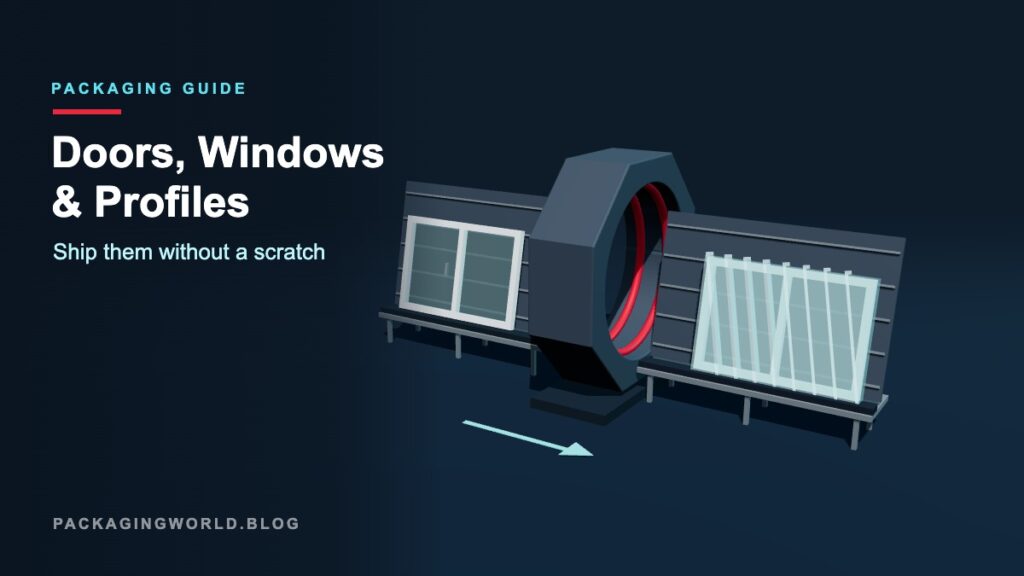
Window and door frames are long and relatively shallow. They are usually fed horizontally through an orbital stretch wrapper, where a rotating ring applies film around the frame as it moves along the conveyor. The ring opening determines the largest cross-section a machine can take, so frame height and depth are the first figures to check. Several manufacturers build wrappers specifically for this job, with ring openings that take frames around 2 metres high.
Door leaves and flat panels have large visible surfaces, so a cushioning layer under the stretch film often pays for itself. Some orbital wrappers apply bubble wrap and stretch film in the same pass, which avoids a separate manual step. Others combine film with cardboard corner or edge protectors.
PVC and aluminium profiles are normally wrapped in bundles straight after extrusion or cutting. Lengths of 6 metres are common, so the wrapping line has to match the speed of the production line feeding it. Bundle wrappers with two film units, rather than one, are a typical way to reach higher throughput.
What a good wrapping spec includes
- Consistent overlap between film turns, so there are no gaps where dust or moisture can get in.
- A suitable film gauge. Stretch film between roughly 23 and 35 micron is common for frames and profiles; heavier products and longer transit justify the thicker end.
- Extra protection where it matters: bubble wrap under the film for finished surfaces, and corner or edge protectors for door leaves.
- Readable labels placed under transparent film or on the outside, so parts can be identified on site without unwrapping.
- Even film tension that holds the pack together without deforming thin profiles.
Manual or automatic?
Hand wrapping can make sense at low volumes or for very varied, one-off products. Its weakness is consistency: overlap and tension change from operator to operator, and film use is hard to control. Automatic orbital wrappers apply the same pattern every time and usually use less film per pack, but they require a higher investment and a clear picture of the product range. For background on the technology, see our overview of orbital wrappers in modern manufacturing.
Five questions before you invest
- What is the smallest and largest cross-section you need to wrap, and how long are your longest parts?
- How many pieces or bundles per shift must the line handle, now and in three years?
- Which protection level do your customers expect: film only, film plus bubble wrap, or film plus corner protection?
- Does the machine need to connect to your production line, labelling or stacking?
- How will new packaging rules affect your material choice? Our 2026 review summarises what the EU packaging regulation means for manufacturers.
Answering these questions before talking to suppliers makes offers easier to compare and helps avoid a machine that is either oversized or too limited for the product mix.
Sources and further reading
Some of the sources we used while preparing this article: