
Stretch film on its own protects against dust, moisture and loose parts, but it does little against knocks. For furniture panels, cabinet doors, profiles and other parts with finished surfaces, many manufacturers add a cushioning layer of bubble wrap underneath. Traditionally that meant two steps: wrap the part in bubble wrap by hand, then stretch wrap it. A growing number of plants now do both in a single pass on one machine. Here is how that works, and when it is worth it.
Why two layers?
The two materials do different jobs. Bubble wrap absorbs impacts and keeps hard surfaces from rubbing against each other. Stretch film holds everything tight, keeps the bubble layer in place and seals the pack against dust and moisture. Used together, they protect high-gloss, lacquered or laminated surfaces far better than either material alone.
The problem is labour. Cutting and taping bubble wrap by hand is slow, inconsistent and wasteful: some parts get too much, others too little, and offcuts pile up next to the packing table.
How a combined wrapper works
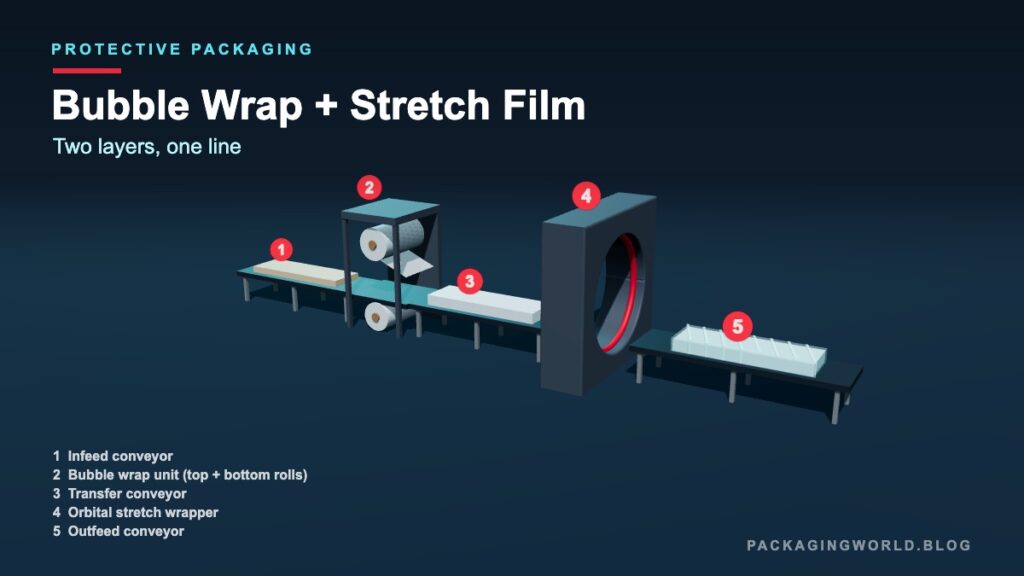
A typical combined line has five sections in a row. Parts arrive on an infeed conveyor and pass through a bubble wrap unit, where one roll above and one below the conveyor lay bubble wrap on the top and bottom faces of the part. A short transfer conveyor carries the cushioned part to an orbital stretch wrapper, whose rotating ring spirals stretch film around it and locks the bubble layer in place. The finished pack leaves on an outfeed conveyor, ready for labelling or stacking.
Because the part keeps moving through each section, length is normally not a limiting factor, and no operator has to cut or tape bubble wrap by hand. The bubble wrap unit and the stretch wrapper can often be set up independently, so the same line can also run with stretch film only when the product does not need cushioning.
Where it pays off
- High-gloss and lacquered panels for kitchens, wardrobes and office furniture, where a single scratch makes the part unsellable.
- Cabinet and furniture doors shipped as separate parts, often over long distances or through parcel networks.
- Window and door profiles with decorative foils or anodised surfaces. We covered this product group in more detail in our door, window and profile packaging guide.
- Export shipments where packs are handled many times and repacking at the destination is not an option.
Limits and trade-offs
A combined wrapper is not the answer for every line. Bubble wrap adds material cost and volume, so for robust or unfinished parts, stretch film alone is often enough. Very heavy or oddly shaped products may need corner protectors or cartons instead. The machine itself is larger and more complex than a film-only wrapper, and changing between products with very different sizes may require adjustment. It also makes sense to check how the bubble wrap is sourced: standard widths and roll diameters keep running costs down.
What to check before buying
- Product range: the smallest and largest cross-section the machine must handle. Thin parts of 18 to 20 mm are common in furniture.
- Throughput: conveyor speed and ring speed decide how many parts per hour the line can wrap.
- Materials: which bubble wrap widths and stretch film gauges the machine accepts. Films between roughly 23 and 35 micron are typical.
- Layout: whether the machine can be linked to the production line before it and labelling or stacking after it.
- Changeover: how quickly operators can switch between products and replace rolls.
For background on how orbital wrapping machines have changed recently, see our article on direct-drive ring technology.
Related reading on furniture packaging
- Optimizing furniture packaging: a guide to logistics and protection
- Operatorless, fully automated flat-pack packaging
- Furniture packaging in 2026: four shifts that defined the year
- Automated furniture packaging lines: panels, cabinets and sofas
- How to choose a box on demand system
Sources and further reading
Some of the sources we used while preparing this article: